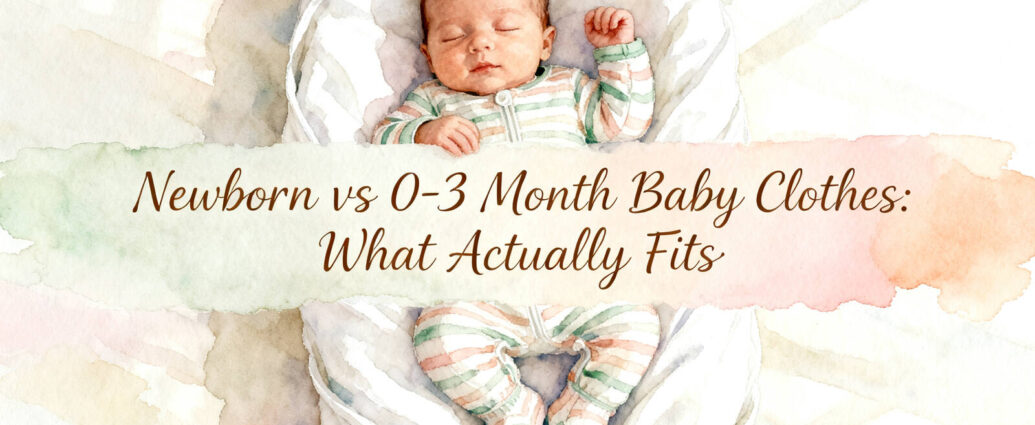
The Short Answer
- Newborn size fits babies roughly 5 to 8 pounds; 0-3 month fits roughly 8 to 12 pounds.
- Most babies wear newborn size for 2 to 4 weeks, if they fit it at all.
- If your baby is projected to arrive at 8 pounds or more, skip newborn and start in 0-3 month.
- Buy 4 to 6 newborn onesies and 3 to 4 footie sleepers at most, then stock up on 0-3 month.
- Length matters as much as weight. A long baby can outgrow newborn sizing before hitting the weight limit.
Newborn size fits babies 5 to 8 pounds and typically lasts only 2 to 4 weeks. Zero-to-3-month size fits babies 8 to 12 pounds. Babies born at 8 pounds or more often skip newborn sizing entirely. Here’s what those size labels actually mean, when newborn clothes are worth buying, and how to avoid donating a drawer of onesies with the tags still on.
Newborn vs 0-3 Month Clothes: The Quick Answer
Newborn and 0-3 month are not the same size. Get it wrong and you’re wrestling snaps that won’t close, or watching a baby disappear into a shirt that hangs past their knees. Weight is the number on the label, but length is often what actually decides fit.
An 8-pound baby born long will have the snaps on a newborn footie sleeper straining across the legs before the weight limit is even reached. A 7-pound compact baby may swim in 0-3 month onesies even though the weight range says they should fit. Both measurements matter.
Brand sizing varies. Carter’s, Gerber, and H&M all cut their newborn sizes differently. One brand’s newborn fits like another brand’s preemie; another brand’s 0-3 month runs so small it fits a 7-pound baby with room to spare. The size label is a starting point, not a guarantee.
Practical rule: if your baby is projected at 8 pounds or more at birth, skip newborn entirely. If projected at 7 to 8 pounds, buy a small number of newborn pieces and have 0-3 month on hand from day one. If expected under 7 pounds, newborn will fit and may last 3 to 4 weeks.
Baby Clothes Size Chart by Weight and Length
The table below shows general size ranges by weight and length. Brands cut differently, so treat these as a starting point, not a guarantee of how any specific item will fit.
| Size | Weight Range | Approx. Length |
|---|---|---|
| Preemie | Under 5 lb | Under 17 in |
| Newborn (NB) | 5 to 8 lb | 17 to 21 in |
| 0-3 months | 8 to 12 lb | 21 to 24 in |
| 3-6 months | 12 to 17 lb | 24 to 26.5 in |
Length is the measurement most parents overlook. A newborn onesie is cut for a torso roughly 17 to 21 inches long; a 0-3 month onesie for roughly 21 to 24 inches. If your baby arrives at 8 pounds and 22 inches long, newborn will be too short across the torso even if the weight label says it fits.
Average birth weight in the US is about 7.5 pounds, according to MedlinePlus newborn data. Average birth length is around 20 inches. Those two numbers put most babies at the top of the newborn weight range and right at the crossover point by length. So the average baby fits newborn clothes for a short window, often 2 to 4 weeks, before moving into 0-3 month.
Babies born at 8 pounds or more may skip newborn entirely and go straight into 0-3 month. Babies born under 6 pounds may need preemie sizing before they grow into newborn. Knowing your baby’s projected size is the most useful thing you can know before making any buying decisions.
What Actually Fits a Newborn
Onesies, footie sleepers, and one-piece rompers are the hardest items to size correctly, because they stretch across both the torso and the legs at the same time. A 0-3 month onesie on a 6-pound baby will have snaps that gap open and armholes that fall past the elbows. It’s wearable in a pinch, but it makes diaper changes harder and the baby ends up less comfortable.
Stretchy items like hats, sleep sacks, and swaddle blankets are more forgiving. A newborn-labeled sleep sack will often still fit a 10-pound baby with room to kick. A 0-3 month hat usually fits a 7-pound head. You don’t need two sizes of those. Pick one and it’ll cover both stages.
Pants and leggings are lower stakes in the newborn stage because most parents keep babies in onesies or sleepers for the first few weeks anyway. If newborn pants end up slightly short on a longer baby, they just look cropped. Normal newborn growth varies a lot in the early weeks, which is part of why the CDC infant care guidance focuses on warmth and comfort over any rigid routine or size schedule.
The safest newborn-size purchase: a small stack of onesies and footie sleepers if your baby is projected under 8 pounds. For everything else, start at 0-3 months and you’ll rarely need to course-correct.
How Many Newborn Clothes Do I Need
For a baby projected at 7 to 8 pounds, buy 4 to 6 newborn onesies and 3 to 4 footie sleepers, then stock up on 0-3 month from the start. Adjust for how often you’ll wash: if you’re doing laundry every two days, the lower end of each range is enough. A full week between washes means adding two or three more pieces per category.
| Item | Newborn qty | 0-3 month qty |
|---|---|---|
| Onesies (short or long sleeve) | 4 to 6 | 6 to 8 |
| Footie sleepers | 3 to 4 | 4 to 6 |
| Pants or leggings | 0 to 2 | 3 to 4 |
| Hats | 1 to 2 | Skip |
| Socks | 3 to 4 pairs | 4 to 6 pairs |
| Swaddle blankets | 3 to 4 (size-agnostic) | N/A |
Stock more 0-3 month than newborn, regardless of your baby’s projected size. Even a baby who fits newborn on arrival will be in 0-3 months within four weeks. Most babies wear 0-3 month for 2 to 3 months, a much longer window. Buying more of the longer-lasting size is almost always the right call, and you won’t end up with a box of barely-worn clothes to sort through later.
Tip: Blowouts can take out two outfits in a row on a bad day. Keep at least one spare complete outfit in your diaper bag and two near the changing area at all times during the newborn stage.
If friends and family are asking what to gift, steer them toward 0-3 month or 3-6 month. Newborn gifts come with the best intentions, but they often arrive after the baby has already moved on.
When to Skip Newborn Size
Skip newborn size entirely if your baby is projected at 8 pounds or more at birth. Buying a size the baby may never wear is one of the most avoidable wastes of money in this stage. Newborn clothes aren’t hard to find after the birth if you end up needing them. Most major retailers stock them year-round, and they’re a quick order or a short store trip away.
Also skip newborn if your baby is expected to arrive significantly early. This sounds counterintuitive, but premature babies typically need preemie sizing, not newborn. Preemie is cut for babies under about 5 pounds. A 4-pound baby in a newborn onesie has the same proportion problem as a 9-pound baby in one, just in the opposite direction. If prematurity is a realistic possibility, ask your care team about sizing before buying anything.
If you genuinely don’t know what size your baby will be, wait. You’ll have a few days at the hospital before you need a full home wardrobe. Most hospital units have basic newborn items on hand, and you won’t leave without something to put the baby in. Buying after birth, once you know the actual weight and length, means buying only what will actually get used.
Tip: If you receive newborn gifts before birth and your baby turns out to be larger, most stores will exchange unopened multipacks for a different size within 90 days. Keep the gift receipts.
What to Buy, What to Skip, and What to Wait On
For the first 4 to 6 weeks, the best newborn clothes are onesies with snap crotches, zipper footie sleepers, and swaddle blankets. A newborn’s day is eat, sleep, diaper, repeat. Separate pieces, structured waistbands, and anything requiring real undressing for a diaper change just make daily care harder than it needs to be. The fewer snaps between you and a clean diaper, the better the 2 a.m. goes.
Anything sized past 0-3 months is easy to buy as you go once you can see what your baby is actually growing into. Seasonal gear like snowsuits and sun hats are worth waiting on too. Buying before birth means guessing what size fits in what specific month, and that guess is usually wrong. The AAP’s newborn stage guidance keeps the focus on warmth and comfort, which a small set of functional basics covers.
One note on gifts: if someone gives you a multi-piece matching set, the onesie or romper will get worn. The coordinating hat, bib, and socks will almost never be used all at the same time. That’s normal, and it’s a good reason to steer gift requests toward basics instead of sets.
Key Takeaways
- Newborn size fits roughly 5 to 8 pounds; 0-3 month fits roughly 8 to 12 pounds. They are not the same size.
- Newborn clothes typically fit for 2 to 4 weeks. Babies arriving at 8 pounds or more often skip newborn entirely.
- Length matters as much as weight. A baby born long can outgrow newborn sizing before hitting the weight limit on the label.
- Buy 4 to 6 newborn onesies and 3 to 4 footie sleepers at most. Stock more 0-3 month items from the start.
- Skip jeans, shoes, matching sets, and button-down shirts for the first 4 to 6 weeks. Basics in stretchy fabric are all you need.
- If you are unsure of your baby’s birth size, wait until after the birth before buying newborn items. They are easy to find quickly.
For newborn clothes, buying less and buying later almost always works better than stocking up before birth. A 7-pound baby needs a handful of onesies and sleepers, not a full wardrobe in every size. If your baby is arriving at 8 pounds or more, go straight to 0-3 month. If you’re not sure, wait until after the birth, or buy a small number of newborn pieces and fill in with 0-3 month from the start. Most babies wear 0-3 month for 2 to 3 months, making it the longer-lasting and better investment. Stock those drawers first, keep the newborn count low, and restock as you go. That approach wastes less, costs less, and gets you through the first month without a box of outfits the baby wore twice sitting in the corner waiting for a consignment sale.
Frequently Asked Questions
What size clothes does a newborn wear?
Most newborns wear newborn size (NB), which is cut for babies around 5 to 8 pounds. Babies born at 8 pounds or more often go straight into 0-3 month from day one. Brand sizing varies, so the label is a useful guide but not a guarantee of how a specific item will actually fit.
Is newborn the same as 0-3 months?
No. Newborn is cut for approximately 5 to 8 pounds; 0-3 month is cut for approximately 8 to 12 pounds. The two sizes overlap at around 8 pounds, but they’re not interchangeable. The difference shows up most clearly in torso length and snap placement on one-piece items.
How many newborn outfits do I need?
For a baby projected at 7 to 8 pounds, 4 to 6 newborn onesies and 3 to 4 footie sleepers is a practical starting count. Newborn size typically fits for 2 to 4 weeks, so buying more than that usually means clothes go unworn.
Should I buy newborn sizes or go straight to 0-3 months?
If your baby is projected at 8 pounds or more, go straight to 0-3 months. If projected at 7 to 8 pounds, buy a small set of newborn pieces and keep 0-3 month on hand. If you’re unsure of the birth size, wait until after delivery before buying any newborn items.
What newborn clothes can I skip buying?
Skip jeans, structured pants, button-down shirts, shoes, and matching multi-piece sets for the newborn stage. Seasonal gear like snowsuits and sun hats are also worth skipping before birth. You can’t predict what size fits in what season until you’re actually in it.
This article is for informational purposes only and does not replace professional medical advice. Always consult your pediatrician about your child’s health.