
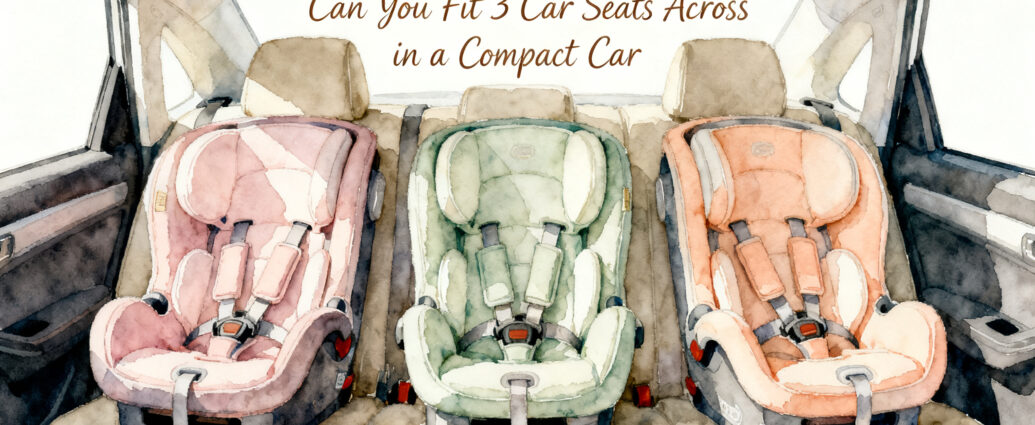
The Short Answer
- 3-across can work, but only with slim seats and enough vehicle hip room.
- Each seat must be 18 in. or less wide (Consumer Reports, 2026).
- Most compact sedans have just 47 to 48 in. of bench (CarSeatMatch, 2026).
- Infant carriers run narrow and are a solid anchor for newborn 3-across setups.
- Buckle receiver access matters as much as seat width; check it before buying.
Can 3 Car Seats Fit in a Compact Car?
Sometimes, but the margin is thin even with the right seats. Whether 3-across works depends on which compact car you drive and how narrow each seat runs.
Car seat safety technicians recommend no wider than 18 inches per seat for a 3-across setup, according to Consumer Reports (2026). Three seats at that limit require a minimum of 54 inches of bench room, plus clearance for the buckle hardware between positions.
Most compact sedans fall short of that target. CarSeatMatch (2026) puts usable bench width for a typical compact sedan at about 47 to 48 inches, which leaves almost no room once buckle gaps are included. That figure rules out standard-width convertibles entirely and is tight even for three of the narrowest slim seats on the market.
Compact SUVs, certain hatchbacks, and larger sedans give parents more to work with. Vehicles with 54 or more inches of rear bench width are where 3-across becomes genuinely realistic. Start with the rear hip room figure in your vehicle’s manufacturer spec sheet.
What Measurements Actually Matter
Three measurements determine whether 3-across works in your vehicle: bench width at belt-path height, buckle receiver position, and each seat’s base width. Two of them are easy to miss.
The first is bench width at belt-path height. That’s at hip height when you slide into the rear seat. CPSC child safety guidance on restraint fit points to the actual usable seating area as the limiting measurement, not the exterior car width or the distance between door panels at headrest level. Door-to-door measurements commonly overstate usable bench by 3 to 6 inches.
The second is buckle receiver position. Each car seat needs to clip into its own buckle without interference from the neighboring seat’s base. A receiver that lands beneath an adjacent seat’s base is a disqualifier even if the seat width clears. This obstacle does not appear in seat-width spec sheets, which is why it catches parents off guard.
The third is each seat’s base width. Most car seats are widest at the base, not at the headrest. Pull the base width from the manufacturer’s current spec page rather than a third-party review that may reference an older model generation.
Tip: Use a soft measuring tape to check bench width at hip height across the full row. Door-to-door or exterior measurements will give you a false read by several inches.
Slim Seat Types That Work Best for 3-Across
Infant carriers work best for newborns in 3-across setups because they run narrower than most convertible seats. They cover a limited age and weight window, so manufacturers keep them compact. One infant carrier with two slim convertibles in the outer positions works for a lot of families in the 0 to 12 month stage.
Among convertible seats, models designed with narrow back rows in mind include the Diono Radian series, Chicco Fit3X, Britax Poplar, Graco SlimFit3 LX, and Evenflo Revolve Slim. Resources like The Car Seat Lady and Car Seat Pros track which vehicle and seat combinations have worked for real families and which slim models come up most often in 3-across discussions. Always verify the current model year’s listed base width before buying.
Standard convertible seats typically run wider than 18 inches and are the most common mismatch for compact-car 3-across setups. High-back boosters are designed for older children outside the 0 to 12 month stage. If a seat is not described as narrow or slim by the manufacturer or a car seat resource, treat it as unlikely to fit in a compact row of three.
Compact Car Scenarios: What Fits and What Does Not
Most rear seats across all vehicle classes measure 50 to 56 inches wide, according to Informed for Life (2026). Vehicles toward the upper end of that range are the realistic 3-across candidates; those at the lower end require the narrowest possible seats and still leave little margin for buckle gaps.
Hip room varies more across compact vehicles than most parents expect. Not every car labeled compact has the same rear bench dimension.
The Subaru Impreza is a frequently cited compact example, with 55.2 inches of rear hip room according to CarMax (2026). That places it near the top of the typical rear-seat range and makes it a workable candidate when paired with slim seats. Not all compact sedans reach that figure, which is why your vehicle measurement comes first, before you shop for seats.
| Bench Width | 3-Across Reality Check |
|---|---|
| Less than 50 in. | Very unlikely even with the slimmest seats available |
| About 47 to 48 in. (compact sedan, CarSeatMatch, 2026) | Marginal; tight for three slim seats, no room for standard convertibles |
| 50 to 56 in. range (Informed for Life, 2026) | Upper end realistic with slim seats; lower end is still a squeeze |
| 55.2 in. (Subaru Impreza, CarMax, 2026) | A verified candidate when paired with slim seats |
What to Skip When Shopping for 3-Across

Standard convertible seats are the most common obstacle for compact 3-across setups. Most run wider than 18 inches, and a single oversize seat blocks the third position entirely. Car and Driver covers what “slim” typically means in practice and identifies models built with narrow row compatibility in mind.
Previous model-year specs are another source of error. Car seat manufacturers frequently update seat dimensions when they refresh a product line. A review from 2023 or 2024 citing a specific base width may not reflect the version currently on store shelves. Pull dimensions from the manufacturer’s current spec page, not from any undated review.
Built-in vehicle boosters in the outboard positions can block adjacent buckle receivers and reduce your usable seating positions. If your rear seat includes a built-in booster, factor its location into your buckle spacing check before assuming all three positions are available. Travel systems that bundle a stroller with a wider infant carrier need a second look; verify the carrier-only base width against your bench measurement before assuming the bundled seat fits.
A Practical 3-Across Buying Plan
Check these four things before buying any seat, in this order, to avoid a combination that won’t fit your vehicle.
- Check your vehicle’s rear hip room in the manufacturer’s spec sheet. Look for interior rear hip room, not headroom or shoulder room. This single number tells you whether 3-across is worth pursuing at all.
- Measure your bench at belt-path height with a soft measuring tape. Run it at sitting level from buckle base to buckle base across the full row, and write down the number before shopping.
- Identify seat candidates and confirm each model’s listed base width from the current manufacturer spec page. Add those three widths together, then add at least 3 to 4 inches for buckle clearance. If the total exceeds your bench measurement, that combination will not work.
- Place all three seats in the vehicle and check buckle access before removing any packaging. If a receiver is blocked, that combination does not work regardless of the width math.
Tip: Some big-box retailers allow in-store test fits when you bring your vehicle. Fitting seats before purchase is far cheaper than shipping three car seats back.
Key Takeaways
- Three seats at 18 in. each require 54+ in. of bench plus buckle clearance; most compact sedans do not reach that total (Consumer Reports, 2026).
- A typical compact sedan bench of 47 to 48 in. (CarSeatMatch, 2026) is tight even for three slim seats and rules out standard-width convertibles.
- Vehicles with 55+ in. of hip room, such as the Subaru Impreza at 55.2 in. (CarMax, 2026), are the most realistic compact car candidates.
- Use a soft tape to measure bench width at belt-path height; door-to-door readings can add 3 to 6 inches that are not real seating room.
- Infant carriers anchor most newborn 3-across setups because they run narrower than full convertibles.
- After placing seats, verify every buckle receiver is accessible; a blocked receiver disqualifies a position even when widths clear on paper.
Getting to a Setup That Works
3-across works when the homework is done before purchasing anything. Check your vehicle’s rear hip room spec first, then measure bench width at belt-path height, then verify each seat candidate’s current base width against those numbers. For families with a newborn, confirm the infant carrier fit first; it’s the most compact piece. Two slim convertibles for the outer positions, verified against the bench measurement, then a buckle access check before removing any packaging. Do that in order and you’ll avoid the most expensive mistake in this setup.
Frequently Asked Questions
Can you fit 3 car seats across in a compact car?
Sometimes. The deciding factor is often buckle access rather than seat width alone. Even seats that clear the width requirement can be disqualified when a buckle receiver lands under a neighboring seat’s base. Verify that all three receivers are accessible after placing seats, before removing packaging.
What is the minimum width needed for 3 car seats across?
The real usable minimum is more than 54 inches. Three 18-inch seats total 54 inches, but that math does not account for buckle gaps between each position. A vehicle at exactly 54 inches of bench typically cannot fit three 18-inch seats cleanly, so vehicles with more than 54 inches are the realistic targets once buckle hardware clearance is included.
Which car seat types are narrowest for 3-across setups?
Infant carriers are among the narrowest options in the 0 to 12 month stage. Among slim convertibles, models like the Diono Radian and Chicco Fit3X are commonly evaluated for 3-across. Check the current model year’s base width on the manufacturer spec page before buying, since seat dimensions change between product generations.
Do rear-facing infant seats take up more room than boosters?
Not in bench width. Base width at sitting level determines 3-across fit, and infant carriers generally run narrower at the base than high-back boosters built for older children. Rear-facing tilts the shell backward, which can reduce front-seat legroom, but it does not increase the seat’s side-to-side footprint on the bench.
What should I measure before buying seats for a 3-across setup?
Measure three things: bench width at belt-path height with a soft measuring tape at sitting level; the spacing between buckle receivers across the row; and each seat’s base width from the current manufacturer spec page. All three measurements together reveal whether a specific vehicle-and-seat combination will actually work.
This article is for informational purposes only and does not replace professional medical advice. Always consult your pediatrician about your child’s health.